

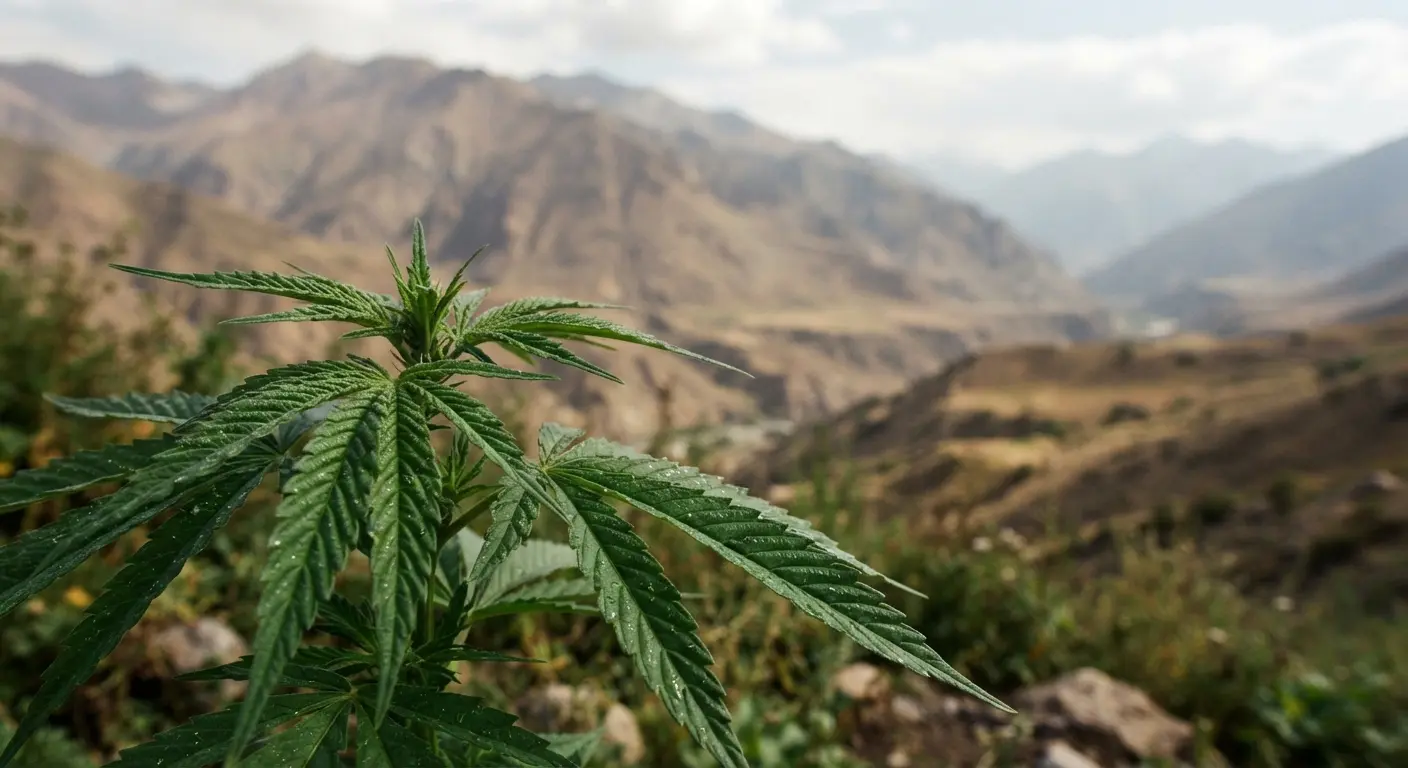
Where Does Wild Cannabis Grow?
Wild cannabis still grows on its own in parts of Central and East Asia, and in re-seeded patches across the American Midwest. None of it resembles the tested, cultivated flower on a dispensary shelf. This guide covers where wild cannabis grows, how it differs from what GW Leaf sells, and why picking it isn’t a shortcut worth taking.
Key Takeaways
- Cannabis was first domesticated in East Asia roughly 12,000 years ago, and its closest living wild relatives still grow there today.
- “Wild” cannabis in the U.S. is almost always feral hemp, also called ditch weed, with THC levels too low to produce a high.
- Wild-growing cannabis is federally illegal to possess or cultivate, regardless of where it’s found or how much THC it contains.
- New Jersey law requires all cannabis to come from a licensed dispensary; home cultivation and foraging are both prohibited.
- Dispensary cannabis is lab-tested for potency and contaminants, something no roadside plant can offer.
What Counts as “Wild” Cannabis?
“Wild cannabis” gets used loosely, and the loose usage causes confusion. Three distinct things get lumped under that one label.
The first is the plant’s true wild ancestor, the untouched population cannabis evolved from before humans ever cultivated it. The second is feral cannabis, a formerly cultivated plant (usually industrial hemp) that escaped fields and now reproduces on its own. The third is a landrace, a variety grown by a regional community for generations without modern breeding, which is naturalized rather than truly wild.
A landrace still involves human hands. Feral cannabis grows without any. That distinction matters for both potency and legal status, and it shapes everything else in this guide.
Where Cannabis Originally Grew
Genetic and archaeological evidence both point to Asia as the plant’s origin point, though researchers still debate exactly where.
The Debate Over a Single Origin Point
A 2021 whole-genome study of 110 cannabis accessions from around the world traced domestication to East Asia, in present-day China, starting around 12,000 years ago. The study found that the closest living relatives of the plant’s wild ancestor are feral populations still growing in China today, not any cultivated variety (Ren et al., Science Advances, 2021). A separate line of research instead places an early domestication center in Central Asia, in present-day Mongolia and northern China, around 12,000 BCE (Cannabis origin and diffusion review, ScienceDirect, 2022).
Archaeological finds support a long, gradual spread rather than one clean starting line. Cannabis seeds recovered from Bronze Age sites across East, Central, and South Asia, including a site in Yunnan, China dated to 1650-400 BC, show the plant already diversifying into distinct fiber and psychoactive types by that period (archaeobotanical study, PMC, 2024). A separate cache of roughly 789 grams of cannabis plant material, radiocarbon-dated to about 2,700 years old and recovered from a burial in Central Asia, tested through phytochemical and genetic analysis as a psychoactive type rather than fiber hemp (Russo et al., Journal of Experimental Botany, cited in PMC).
How Sativa and Indica Trace to Different Regions
The familiar “sativa” and “indica” labels have real geographic roots, even if modern hybrids have blurred them. A 2020 peer-reviewed taxonomic study traced “sativa”-type cannabis to South Asian origin, primarily India, and “indica”-type cannabis to Central Asian origin, spanning Afghanistan, Pakistan, and the historical region of Turkestan (McPartland & Small, PhytoKeys, 2020). The same study found that the wild-growing relatives of these domesticated types still grow in those same regions, and can be told apart from cultivated cannabis partly by their THC-to-CBD ratio.
That said, 50 years of crossbreeding has scrambled most of these lines. The study notes that today’s “sativa” and “indica” strain labels are usually based on THC-to-CBD ratio alone, not on a documented wild or regional lineage.
How Cannabis Spread Beyond Asia
As cannabis moved along historical trade and migration routes, distinct regional populations took hold outside Asia as well, adapting to local climates over generations under continued human cultivation. This is the origin story behind many of the strain names still used in the industry today, even when the modern product sold under that name has been crossbred many times since. None of these regional populations are truly wild in the strict sense; they persisted through ongoing human cultivation, which is what separates a landrace from feral cannabis.
Feral Cannabis in the United States
The cannabis growing wild across parts of the American Midwest today isn’t a leftover of the plant’s ancient range. It’s feral industrial hemp, and its story starts with 19th and 20th century American agriculture.
From Farm Crop to Roadside Weed
Commercial hemp cultivation began in Missouri around 1835, and by 1844 the state was producing an estimated 12,500 tons of fiber a year (Dewey, USDA Yearbook of Agriculture, 1913). Hemp farming expanded through the Midwest over the following decades. When large-scale cultivation eventually declined, the crop didn’t disappear. It kept reseeding itself in ditches, field edges, and disturbed soil, which is where the term “ditch weed” comes from.
Why the DEA Spent Decades Eradicating It
The federal government’s response to feral hemp became one of the odder chapters in U.S. drug policy. Since 1979, the DEA has run the Domestic Cannabis Eradication/Suppression Program, targeting both cultivated marijuana and feral cannabis. The agency’s own data shows how lopsided the results were: of an estimated 247 million cannabis plants destroyed nationwide in 2003, more than 243 million were classified as ditch weed rather than cultivated marijuana (DEA data, reported by NORML, 2004). The DEA defines ditch weed as “wild, scattered marijuana plants [with] no evidence of planting, fertilizing, or tending” (same source). Indiana alone accounted for more than 219 million of those plants that year, far more than any other state.
Feral hemp still grows today, concentrated in Indiana, Illinois, Kansas, Missouri, and Nebraska, generally in disturbed soil like ditches, field margins, and old farmland rather than untouched wilderness (USDA ecological niche modeling study, Ecology and Evolution, 2024). Seven Midwestern states have formally classified it as a noxious weed, and recent occurrence data shows volunteer hemp populations now establishing well outside that traditional range too, including in southern Florida (invasive species study, Invasive Plant Science and Management, 2025).
Wild Cannabis vs. Dispensary Cannabis
The gap between what grows on its own and what’s sold at a licensed dispensary comes down to breeding, testing, and consistency.
|
Feature |
Wild or Feral Cannabis |
Dispensary Cannabis |
|
THC content |
Very low; bred for fiber, not potency |
Selectively bred and consistently measured |
|
Lab testing |
None |
Required before sale in New Jersey |
|
Contaminants |
Unknown; roadside soil can carry pesticide runoff or heavy metals |
Screened as part of state-mandated testing |
|
Legal status |
Federally illegal to possess or grow |
Legal to purchase from a licensed NJ dispensary |
|
Consistency |
Varies wildly plant to plant |
Labeled by strain, batch, and cannabinoid content |
Is It Legal to Pick or Grow Wild Cannabis?
No, and this is the part most guides on this topic skip entirely.
Federal Law Doesn’t Care Where the Plant Came From
Cannabis is classified as a Schedule I controlled substance under the federal Controlled Substances Act, its most restrictive category, and that classification applies regardless of whether a plant was cultivated or found growing on its own (Congressional Research Service, 2025). In April 2026, the DEA moved specifically FDA-approved marijuana products and state-licensed medical marijuana to Schedule III. Every other form of marijuana, including unlicensed, wild-growing, or adult-use recreational cannabis, remains Schedule I (U.S. Department of Justice, April 2026).
There’s one narrow exception. The 2018 Farm Bill removed hemp, defined as cannabis containing no more than 0.3% delta-9 THC by dry weight, from the federal definition of marijuana (FDA congressional testimony, 2019). But a wild plant’s THC content can’t be known without lab testing, so picking one and hoping it qualifies as hemp isn’t a safe assumption to make.
New Jersey Requires a Licensed Dispensary
New Jersey legalized adult-use cannabis through the CREAMM Act, and licensed retail sales began April 21, 2022 (State of New Jersey, Cannabis Regulatory Commission). The state’s Cannabis Regulatory Commission is direct about where legal cannabis has to come from: purchasing cannabis from anywhere other than a licensed dispensary is illegal, and the safety of that product “cannot be guaranteed” (NJ-CRC FAQs). Home cultivation remains prohibited in New Jersey for both medical and adult-use consumers.
From Ancient Roots to Today’s Dispensary Shelf
Wild cannabis is a real, well-documented part of the plant’s history, from its origins in Asia to the feral hemp still growing across the Midwest. None of that history changes what’s legal to possess in New Jersey today. Every strain on a dispensary shelf carries a thread of that same genetic story, just bred, tested, and labeled for a very different experience than anything found growing on its own.
Explore GW Leaf’s Strain Selection
Every strain in GW Leaf’s lineup is lab-tested, clearly labeled, and sourced from licensed growers, so you know exactly what you’re getting before you buy. Stop by any GW Leaf location, or browse what’s in stock online, to see how far selective breeding has come from the plant’s wild roots.
Frequently Asked Questions
Is wild cannabis the same thing as marijuana? Botanically, yes; wild and feral cannabis are the same species as cultivated marijuana. Legally, they’re treated the same way too, since federal law doesn’t distinguish based on where a plant grew.
Can you get high from wild cannabis found in the U.S.? Unlikely. Most wild cannabis found in the U.S. is feral hemp, bred over generations for fiber rather than potency, and it typically carries very little THC.
Is it legal to pick wild cannabis in New Jersey? No. Cannabis remains federally illegal to possess regardless of where it’s found, and New Jersey law requires that all legal cannabis come from a licensed dispensary.
What’s the difference between wild cannabis and a landrace strain? Feral or truly wild cannabis grows and reproduces with no human involvement. A landrace strain is naturalized to a specific region but is still grown and selected by people, generation after generation.
Where in the U.S. does cannabis still grow wild today? Feral hemp persists in disturbed soil like ditches and field edges across parts of Missouri, Nebraska, Iowa, Minnesota, Oklahoma, and Indiana, a legacy of historical hemp farming in those states.
Cannabis remains illegal under federal law. Products purchased at GW Leaf are intended for use only within the state of New Jersey. Transporting cannabis across state lines, even between two states where cannabis is legal, is a federal offense. Please consume responsibly and within your state’s borders.
This product contains cannabis. For use only by adults 21 years of age or older. Keep out of the reach of children. There may be health risks associated with the consumption of this product, including for women who are pregnant, breastfeeding, or planning on becoming pregnant. Do not drive a motor vehicle or operate heavy machinery while using this product.
GW Leaf is a cannabis business licensed by the State of New Jersey.