

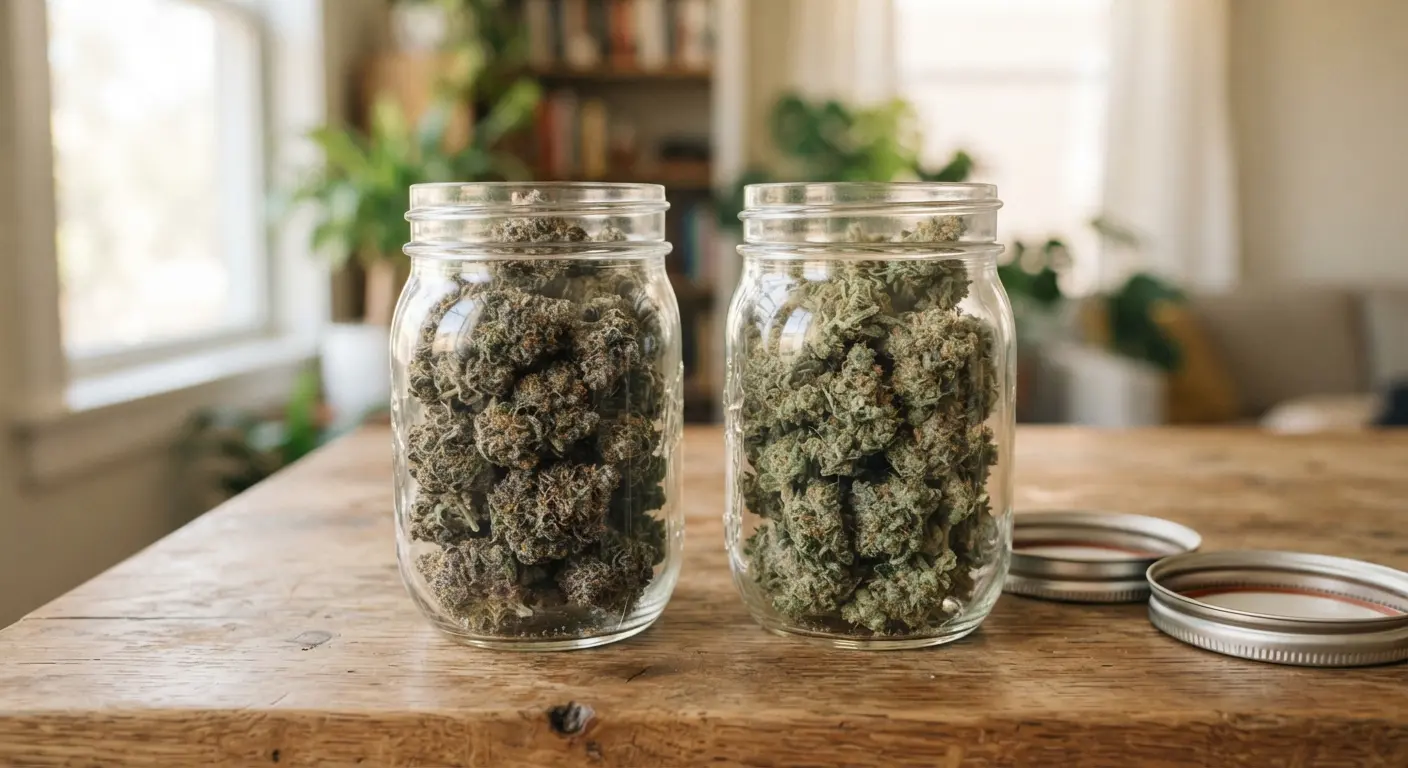
Sativa vs. Indica: The Short Answer
Sativa vs. indica is the oldest shorthand in cannabis, but it describes plant shape and history far more than it predicts how a product will make you feel. The terms began as a botanical split, not an effects chart. A 2022 analysis of more than 40,000 commercial samples found that indica, sativa, and hybrid labels did not reliably match the actual chemical makeup of the product inside the jar.
That doesn’t mean the labels are useless. It means the real answer to “what will this do” lives in the cannabinoid and terpene numbers on the lab report, not the strain category on the shelf tag. This guide walks through both, plus how to use New Jersey’s own product labels to shop smarter.
Key Takeaways
- Sativa and indica started as descriptions of plant height, leaf shape, and geographic origin, not guaranteed effects.
- A large 2022 study found commercial indica/sativa/hybrid labels didn’t consistently match products’ actual chemistry.
- Terpenes and cannabinoid ratios are better predictors of how a product feels than the strain category alone.
- New Jersey’s own packaging rules already sort cannabis by lab-tested THC and CBD content, not by strain name.
- Reading a product’s Certificate of Analysis is the most reliable way to shop for a specific experience.
Where “Sativa” and “Indica” Actually Come From
The sativa and indica names started as plant taxonomy, not a promise about your evening. Botanists Ernest Small and Arthur Cronquist formalized the split in 1976, grouping cannabis plants by structure and geography rather than reported effects. Their fiber-type threshold, under 0.3% THC in dried female flowers, still defines legal hemp under federal law today.
A 2020 taxonomic paper traces the historical roots further. Sativa-type landraces trace back to South Asia, while indica-type landraces are tied to Central Asian regions such as Afghanistan and Pakistan. Sativa plants tend to grow tall with narrow leaves, suited to warmer equatorial climates. Indica plants grow shorter and bushier, a shape suited to the harsher Hindu Kush mountain range.
None of this described how the plant would make a person feel. That connection came later, built by growers, sellers, and word of mouth rather than by the original botanical definition.
Why the Labels Stopped Matching the Plant
Modern cannabis breeding broke the clean link between a name and its chemistry. A 2022 study analyzing over 40,000 commercial samples across six states found that indica, hybrid, and sativa labels did not reliably align with the cannabinoid and terpene content lab tests actually measured. Two products both labeled “indica” could sit in completely different chemical categories, while an “indica” and a “sativa” sample sometimes matched closely.
A separate 2021 genetic study of 23 commercially sold Canadian strains reached a similar conclusion. Testing the plants’ DNA showed genetic structure that often didn’t match the sativa, indica, or hybrid ancestry claimed on the label. Decades of crossbreeding mean most products on a dispensary shelf are hybrids in some form, whatever the tag says.
This isn’t a reason to distrust every strain name you see. It’s a reason to treat the name as a starting point for conversation with a budtender, not the final word on what you’re buying.
What Actually Shapes an Effect: Cannabinoids and Terpenes
If the strain label isn’t the reliable predictor, the plant’s actual chemistry is where the more useful answer lives. Two categories matter most: cannabinoids like THC and CBD, and terpenes, the aromatic compounds responsible for a product’s smell and flavor.
Researcher Ethan Russo’s often-cited 2011 paper proposed that terpenes and cannabinoids interact with each other rather than acting alone, an idea known as the entourage effect. Since then, individual terpenes have drawn their own research attention:
- Myrcene: commonly associated with a relaxed, mellow feeling; found in high concentration in many traditionally “indica” labeled products.
- Limonene: associated with an uplifted, energized mood; in a small zebrafish study, both limonene and myrcene reduced anxiety-like behavior after a single acute dose, though the effect did not hold up after seven days of repeated exposure.
- Pinene: linked in early research to alertness and clearer focus.
- Linalool: studied for a calming effect; a human trial found a linalool-and-myrcene scent improved mood and task performance versus a neutral control scent.
- Caryophyllene: the only terpene shown to bind directly to the body’s CB2 receptor; in mouse studies, it reduced inflammatory and nerve-related pain signals through that pathway.
These findings describe how these compounds behave in lab and animal studies, not a guarantee of what any specific product will do for you. Individual body chemistry, tolerance, and dose all shape the actual experience.
New Jersey Already Grades Cannabis This Way
New Jersey’s own regulations have quietly moved past the sativa/indica system already. Every cannabis product sold at a licensed New Jersey dispensary must be tested by a licensed third-party lab for potency and for contaminants like pesticides, heavy metals, mold, and bacteria before it reaches a shelf.
The state’s packaging and labeling guidance goes further. Labels must display a calculated Total THC and Total CBD figure, derived directly from lab results rather than a marketing category. That’s the same chemistry-first logic the research above points to, just written into New Jersey’s cannabis code.
Packaging also has to carry a universal cannabis symbol and meet child-resistant, tamper-proof, and opaque standards under state rules. The New Jersey Cannabis Regulatory Commission (CRC) oversees the whole system, and under the CREAMM Act, only residents 21 and older can legally purchase these products. Every one of these numbers is available to you on request, whether it’s printed on the package or in the Certificate of Analysis behind the counter.
Choosing at the Counter in Fort Lee
Shopping by chemistry instead of category takes about thirty extra seconds and gets you a far more reliable result. A few habits make the difference:
- Ask to see the Certificate of Analysis (COA). Every licensed NJ dispensary can provide one for any product on request. It shows the actual cannabinoid and terpene percentages, not just a strain name.
- Look at the dominant terpene, not just the strain tag. A high-myrcene product will likely feel different from a high-limonene or high-pinene product, regardless of what the label calls it.
- Start low if you’re newer to a product or format. Effects vary by dose, tolerance, and individual body chemistry.
- Ask your budtender for a comparison, not just a name. Describing the feeling you’re after, relaxed, social, focused, gets you a better match than asking for “an indica” or “a sativa” alone.
One local note worth clearing up: even with 2026’s federal rescheduling news, adult-use recreational cannabis remains a Schedule I substance under federal law. That rescheduling order applies only to FDA-approved drug products and state-licensed medical marijuana, not to the adult-use products sold at dispensaries like ours. New Jersey’s own legal market, and the CRC rules described above, are what govern a purchase made here.
Sativa vs. Indica vs. Hybrid at a Glance
These are general associations drawn from traditional labeling and terpene research, not guarantees for any specific product. Always check the COA for what’s actually in your product.
Category | Traditional Association | Common Dominant Terpenes | Best Checked Via |
Sativa-Leaning | Uplifted, social, energized | Limonene, pinene | Product’s COA terpene panel |
Indica-Leaning | Relaxed, calm, mellow | Myrcene, linalool | Product’s COA terpene panel |
Hybrid/Balanced | Blend of both, varies widely | Mixed profile, often caryophyllene present | Product’s COA terpene panel |
The Label Gets You in the Door, the Chemistry Gets You Home
Sativa and indica are still useful shorthand for starting a conversation about what you’re looking for. They just aren’t the finish line. The terpene and cannabinoid numbers on a product’s Certificate of Analysis are the part actually built to predict your experience, and New Jersey’s own labeling rules already point shoppers there.
Next time you’re picking something out, ask to see the numbers behind the name. It’s a small habit that makes a real difference in matching the product to the moment you’re shopping for.
Explore Indoor Treez’s Menu
Our Fort Lee counter team can walk you through any product’s terpene profile in person, no chemistry degree required. Browse today’s tested flower, pre-rolls, and more on our current menu, or stop by and ask us anything.
Frequently Asked Questions
Is indica always more relaxing than sativa?
Not reliably. A 2022 study of over 40,000 samples found strain labels didn’t consistently match a product’s actual terpene and cannabinoid content, so an “indica” can vary widely from one product to the next.
What’s the fastest way to tell how a product might feel?
Ask to see its Certificate of Analysis and look at the dominant terpene and THC-to-CBD ratio, rather than relying on the strain category alone.
Are hybrid strains just a mix of indica and sativa genetics?
Often, yes, but the label doesn’t guarantee a predictable middle-ground effect. A 2021 genetic study found many commercial hybrids didn’t clearly reflect their marketed ancestry.
Do I need a medical card to buy at Indoor Treez?
No. Indoor Treez serves adult-use customers 21 and older under New Jersey’s CREAMM Act; no medical card is required.
Why do terpenes matter if THC is the main active ingredient? Terpenes are believed to interact with cannabinoids like THC, an idea called the entourage effect, and individual terpenes like caryophyllene and limonene have their own studied effects on mood and pain pathways.
Cannabis remains illegal under federal law. Products purchased at Indoor Treez are intended for use only within the State of New Jersey. Transporting cannabis across state lines, even between two states where cannabis is legal, is a federal offense. Please consume responsibly and within New Jersey’s borders. [CONFIRM: verify this warning’s current required wording against the NJ Cannabis Regulatory Commission’s consumer-facing requirements before publishing.]
These statements have not been evaluated by the Food and Drug Administration. This product is not intended to diagnose, treat, cure, or prevent any disease. Cannabis products should not be used by pregnant or breastfeeding individuals. Keep out of reach of children and pets. For use only by adults 21 and older. Consult a physician before use if you have a medical condition or take prescription medications. [CONFIRM: verify current FDA disclaimer wording and any additional NJ-CRC-required consumer warnings before publishing.]